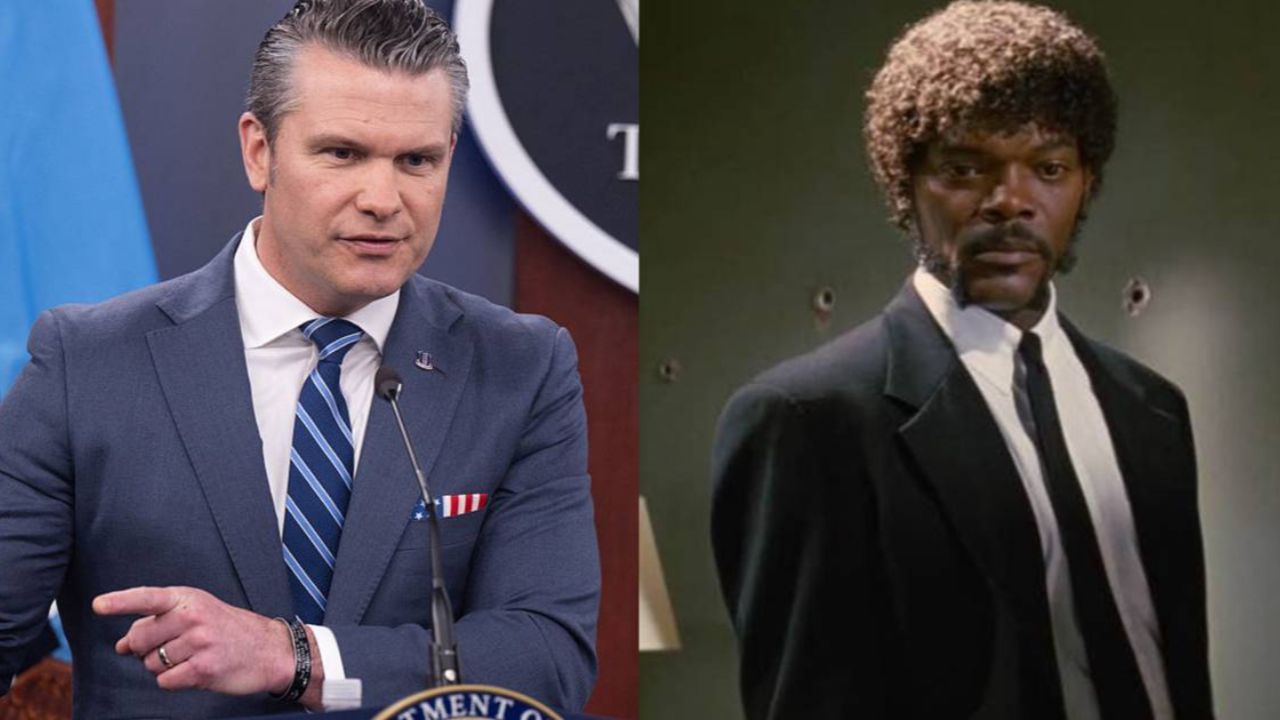

Defense Secretary Pete Hegseth stood before a packed worship service at the Pentagon on April 15, 2026, and invited those gathered to join him in a special prayer. What followed was not a direct reading from scripture but a customized invocation tied to a recent combat search-and-rescue mission in Iran. Hegseth introduced the passage as “CSAR 25:17,” suggesting it reflected the biblical book of Ezekiel, yet the words he recited bore a striking resemblance to a monologue from Quentin Tarantino’s 1994 film Pulp Fiction. The moment, captured on video, quickly spread across social media and news outlets, sparking widespread discussion about the intersection of Hollywood fiction, military tradition, and religious observance in the highest levels of government.
At first glance, the prayer seemed like a heartfelt tribute to American service members. Hegseth described it as one recited by the “Sandy 1” team during a daring daylight rescue of a downed fighter pilot. Yet the near-verbatim overlap with Samuel L. Jackson’s character in Pulp Fiction—a scene where a hitman dramatically cites scripture before violence erupts—left many observers puzzled. Hegseth never claimed the text was an exact biblical quotation, but his reference to Ezekiel 25:17 invited scrutiny. The episode highlighted how cultural touchstones can blur the lines between fact and fiction, especially when invoked in solemn official settings.
You Might Like: Who Are Justin Fairfax’s Kids? Meet 16-Year-Old Cameron and 14-Year-Old Carys
The Adapted Prayer and Its Military Context
During the service, Pete Hegseth asked attendees to pray with him as he read the CSAR 25:17 passage aloud. “The path of the downed aviator is beset on all sides by the inequities of the selfish and the tyranny of evil men,” he began. “Blessed is he who in the name of camaraderie and duty shepherds the lost through the valley of darkness, for he is truly his brother’s keeper and the finder of lost children.”
The prayer built to a climactic vow of retribution: “And I will strike down upon thee with great vengeance and furious anger those who attempt to capture and destroy my brother, and you will know my call sign is Sandy 1 when I lay my vengeance upon thee.”
Pete Hegseth quoted a fake Bible verse from Pulp Fiction during a Pentagon sermon.pic.twitter.com/1o3CJiJYRF
— Clash Report (@clashreport) April 16, 2026
Hegseth explained that the text originated with the lead planner for the “Sandy 1” unit involved in extracting the pilot, code-named Dude 44 Alpha, from hostile territory in Iran. The reference to “CSAR 25:17” cleverly nodded to Ezekiel while adapting the language to fit a modern rescue operation. Subtle changes—replacing “righteous man” with “downed aviator” and “charity and good will” with “camaraderie and duty”—made the prayer feel tailored for warfighters facing real peril. In Hegseth’s telling, it served as a rallying cry of protection and vengeance, perfectly suited to the high-stakes mission.
More Read
Fiction, Scripture, and the Debate That Followed
The roots of this prayer trace back to Pulp Fiction, where Jackson’s character Jules Winnfield dramatically recites an extended, invented version of Ezekiel 25:17 before executing a target. Tarantino and co-writer Roger Avary crafted the monologue as a stylistic flourish, borrowing only the final line of vengeance from the actual Bible verse. In the King James Version, Ezekiel 25:17 is far shorter and more straightforward: it declares God’s judgment on the Philistines with “great vengeance” and “furious rebukes,” ending with the recognition that “I am the Lord.” The film’s embellished passage, filled with poetic imagery of shepherds, valleys of darkness, and brotherly keepers, is entirely fictional—yet it has become one of cinema’s most quoted “Bible” scenes.
Also See: Tina Campbell Opens Up: Her Blended Family, Kids’ Names, and Proud Mom Moments
Critics quickly pointed out the mismatch, accusing Hegseth of misleading his audience by linking the prayer so directly to scripture. Supporters, including Pentagon spokespeople, pushed back, insisting the CSAR version was a legitimate custom prayer inspired by the verse, much like the movie dialogue itself drew loose inspiration. They emphasized that Hegseth had clearly framed it as a reflection, not a verbatim quote, and praised its use as a morale booster for troops. The controversy underscored broader tensions: how leaders balance personal faith, cultural references, and official duties in an era when every word can be instantly dissected online.
Ultimately, Pete Hegseth’s choice revealed more about the enduring power of Pulp Fiction than any theological error. The prayer fused Hollywood drama with military resolve, reminding listeners that even ancient texts can be reimagined for contemporary battles. Whether viewed as clever adaptation or careless blending, the episode ensured that Ezekiel 25:17—and its cinematic cousin—will remain part of the national conversation for some time.